RE-WIRE
UNDERSTANDING COGNITIVE FUNCTION, MENTAL CLARITY & PEPTIDE RESEARCH
RE-WIRE is an educational resource about brain health, cognitive function, mental clarity, and current research involving PINEALON, Selank, and PE 22-28.
SCIENCE
INFORMS
HEALTHIER
TOMORROWS
KNOWLEDGE
SUPPORTS
INFORMED
CONVERSATIONS
Neural Signaling, Synaptic Plasticity & Cognitive Networks
How complex neural networks, neurotransmitters, receptors, and peptide messengers coordinate focus, memory, executive processing, and emotional balance.
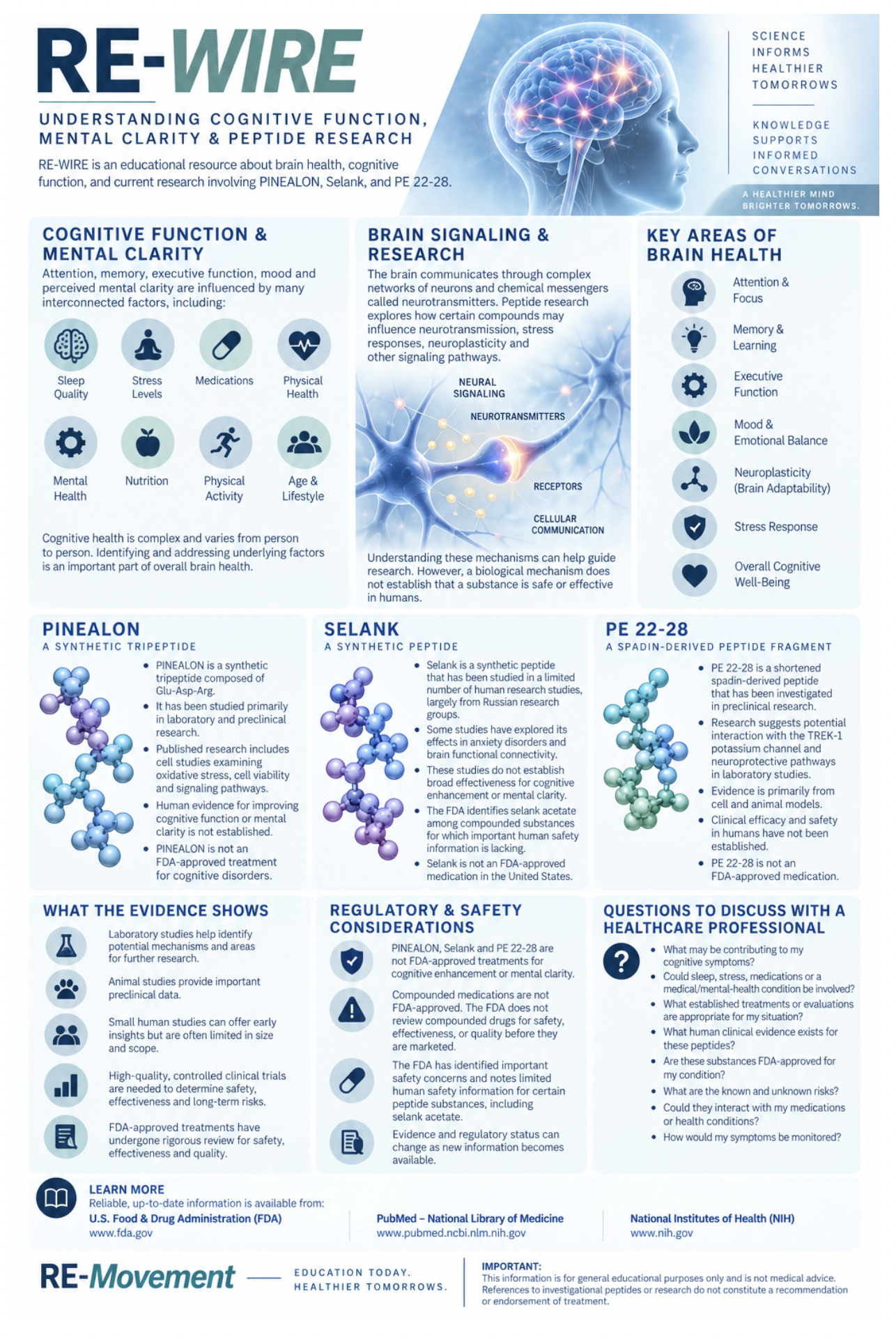
COGNITIVE FUNCTION & MENTAL CLARITY
Attention, memory, executive function, mood and perceived mental clarity are influenced by many interconnected factors, including:
BRAIN SIGNALING & RESEARCH
The brain communicates through complex networks of neurons and chemical messengers called neurotransmitters. Peptide research explores how certain compounds may influence neurotransmission, stress responses, neuroplasticity and other signaling pathways.
Neurons transmit electrical and chemical messages across synapses via neurotransmitter release, receptor binding, and cellular communication cascades.
KEY AREAS OF BRAIN HEALTH
PINEALON
A SYNTHETIC TRIPEPTIDE
- •PINEALON is a synthetic tripeptide composed of Glu-Asp-Arg.
- •It has been studied primarily in laboratory and preclinical research.
- •Published research includes cell studies examining oxidative stress, cell viability and signaling pathways.
- •Human evidence for improving cognitive function or mental clarity is not established.
- •PINEALON is not an FDA-approved treatment for cognitive disorders.
SELANK
A SYNTHETIC PEPTIDE
- •Selank is a synthetic peptide that has been studied in a limited number of human research studies, largely from Russian research groups.
- •Some studies have explored its effects in anxiety disorders and brain functional connectivity.
- •These studies do not establish broad effectiveness for cognitive enhancement or mental clarity.
- •The FDA identifies selank acetate among compounded substances for which important human safety information is lacking.
- •Selank is not an FDA-approved medication in the United States.
PE 22-28
A SPADIN-DERIVED PEPTIDE FRAGMENT
- •PE 22-28 is a shortened spadin-derived peptide that has been investigated in preclinical research.
- •Research suggests potential interaction with the TREK-1 potassium channel and neuroprotective pathways in laboratory studies.
- •Evidence is primarily from cell and animal models.
- •Clinical efficacy and safety in humans have not been established.
- •PE 22-28 is not an FDA-approved medication.
WHAT THE EVIDENCE SHOWS
Laboratory studies help identify potential mechanisms and areas for further research.
Animal studies provide important preclinical data.
Small human studies can offer early insights but are often limited in size and scope.
High-quality, controlled clinical trials are needed to determine safety, effectiveness and long-term risks.
FDA-approved treatments have undergone rigorous review for safety, effectiveness and quality.
REGULATORY & SAFETY CONSIDERATIONS
PINEALON, Selank and PE 22-28 are not FDA-approved treatments for cognitive enhancement or mental clarity.
Compounded medications are not FDA-approved. The FDA does not review compounded drugs for safety, effectiveness, or quality before they are marketed.
The FDA has identified important safety concerns and notes limited human safety information for certain peptide substances, including selank acetate.
Evidence and regulatory status can change as new information becomes available.
QUESTIONS TO DISCUSS WITH A HEALTHCARE PROFESSIONAL
- •What may be contributing to my cognitive symptoms?
- •Could sleep, stress, medications or a medical/mental-health condition be involved?
- •What established treatments or evaluations are appropriate for my situation?
- •What human clinical evidence exists for these peptides?
- •Are these substances FDA-approved for my condition?
- •What are the known and unknown risks?
- •Could they interact with my medications or health conditions?
- •How would my symptoms be monitored?
LEARN MORE
Reliable, up-to-date information is available from:
www.fda.gov
www.pubmed.ncbi.nlm.nih.gov
www.nih.gov
RE-WIRE: Understanding Cognitive Function, Mental Clarity & Peptide Research
An educational resource about brain health, cognitive function, mental clarity, and current research involving Pinealon, Selank, and PE 22-28.
RE-WIRE is an educational resource about brain health, cognitive function, mental clarity, and current research involving Pinealon, Selank, and PE 22-28.
Cognitive function includes processes such as attention, memory, learning, executive function, information processing, and decision-making.
Perceived mental clarity and cognitive performance can be influenced by many factors, including sleep, stress, medications, nutrition, physical activity, mental health, medical conditions, age, and lifestyle.
Researchers continue to investigate peptides and other compounds that may influence neurological signaling and brain function. The available evidence varies substantially among individual substances.
Understanding Cognitive Function
The brain communicates through complex networks of neurons, neurotransmitters, receptors, and other signaling systems. Normal cognitive function involves multiple interconnected processes, including:
Changes in concentration, memory, or perceived mental clarity can have many potential causes. Understanding and addressing those underlying factors is an important part of evaluating cognitive concerns.
Pinealon
Pinealon is a synthetic tripeptide composed of the amino acids Glu-Asp-Arg.
Published research has investigated Pinealon in experimental models involving oxidative stress, cellular viability, signaling pathways, and neurological aging.
Laboratory studies have reported biological effects involving reactive oxygen species and cellular processes. These findings provide information about potential mechanisms but do not establish clinical effectiveness in humans. PubMed
Available human clinical evidence supporting Pinealon for improving cognition, memory, focus, or mental clarity is limited.
Pinealon is not an FDA-approved treatment for cognitive impairment or cognitive enhancement in the United States.
Selank
Selank is a synthetic peptide that has been investigated primarily for potential effects involving anxiety and neurological signaling.
Unlike some experimental peptides, Selank has been evaluated in published human studies.
A randomized study involving 62 patients with generalized anxiety disorder and neurasthenia compared Selank with medazepam and reported effects on anxiety-related measures. Other published studies have investigated Selank in patients with anxiety-spectrum disorders. PubMed
Research has also explored possible effects of Selank on brain functional connectivity. A study involving 52 healthy participants used resting-state functional MRI to examine changes in connectivity involving brain regions associated with anxiety and executive function. PubMed
These studies are relevant to ongoing research but do not establish Selank as a broadly effective cognitive enhancer or treatment for mental clarity.
Selank is not an FDA-approved medication in the United States.
PE 22-28
PE 22-28 is a shortened peptide derived from research involving spadin, a peptide associated with the TREK-1 potassium channel.
TREK-1 is an ion channel studied for its role in neuronal activity and other neurological processes.
Laboratory and animal research has investigated PE 22-28 in relation to TREK-1 activity and experimental models relevant to antidepressant research.
Published preclinical research reported that PE 22-28 interacted with TREK-1 and demonstrated activity in laboratory and animal models. PubMed
These findings are preclinical. They do not establish that PE 22-28 improves mood, cognition, memory, focus, or mental clarity in humans.
Human clinical evidence establishing its safety or effectiveness has not been demonstrated.
PE 22-28 is not an FDA-approved medication.
Understanding the Evidence
The evidence involving Pinealon, Selank, and PE 22-28 is not equivalent. Research ranges from:
- Cellular studies
- Laboratory research
- Animal models
- Mechanistic research
- Small human studies
- Clinical studies in specific patient populations
Selank has published human research, particularly involving anxiety disorders. Pinealon and PE 22-28 have substantially more limited clinical evidence supporting proposed cognitive applications.
A biological mechanism or positive laboratory finding does not establish clinical effectiveness.
Likewise, findings from a small study involving a specific patient population should not automatically be generalized to healthy individuals or other medical conditions.
Cognitive and Mental Health
Changes in concentration, memory, attention, mood, or perceived mental clarity can have numerous causes. Healthcare professionals may consider factors such as:
Persistent or significant cognitive symptoms warrant appropriate medical evaluation rather than assuming they result from a single neurological pathway.
Regulatory and Safety Considerations
Pinealon, Selank, and PE 22-28 are not FDA-approved treatments for cognitive enhancement or mental clarity in the United States.
FDA currently identifies Selank acetate (TP-7) among compounded bulk drug substances for which the agency has identified potential significant safety risks. FDA states that compounded Selank acetate may pose immunogenicity risks for certain routes of administration and that important human safety information is lacking. U.S. Food and Drug Administration
Compounded medications are not FDA-approved. FDA does not review compounded drugs for safety, effectiveness, or quality before they are marketed. U.S. Food and Drug Administration
The absence of extensive safety information is particularly important when considering experimental substances intended to affect neurological function.
Questions to Discuss With a Healthcare Professional
Patients learning about cognitive health and peptide research may wish to ask:
- •What may be contributing to my cognitive symptoms?
- •Could sleep, stress, medications, or a medical condition be involved?
- •Should my symptoms receive further medical evaluation?
- •What established treatments are available for my circumstances?
- •What human clinical evidence exists for the substance being discussed?
- •Is the substance FDA-approved for my condition?
- •What is known about its short- and long-term safety?
- •What risks or uncertainties remain unknown?
- •Could it interact with my medications or health conditions?
- •How would my symptoms and cognitive health be monitored?
Continuing Research
Research into cognitive function, neurobiology, stress, mood, neuroplasticity, and peptide signaling continues to evolve.
Pinealon, Selank, and PE 22-28 have been investigated in different experimental settings, but their evidence bases differ considerably.
Selank has been examined in several human studies involving anxiety disorders and in research examining brain functional connectivity. Pinealon research includes cellular and preclinical investigations, while PE 22-28 research has focused substantially on laboratory and animal models involving TREK-1. PubMed
Additional controlled human research is needed to establish safety, effectiveness, appropriate dosing, potential interactions, and long-term outcomes for investigational applications.
Patients should distinguish between biological mechanisms, preclinical findings, limited human research, and FDA-approved treatments when evaluating information about peptides and cognitive health.
Educational Resources
Certain Bulk Drug Substances for Use in Compounding that May Present Significant Safety Risks
Human Drug Compounding
Selank and Generalized Anxiety Disorders
Pinealon and Cellular Research
PE 22-28 / Spadin Research
Educational Disclaimer
This page is provided for general educational purposes only. It is not intended to provide medical advice, diagnosis, or treatment.
References to peptides, neurological pathways, biological mechanisms, laboratory research, animal studies, or areas of clinical investigation are provided for educational purposes and should not be interpreted as a recommendation or endorsement of a particular substance or treatment.
Discussion of an investigational substance does not establish that the substance is safe, effective, FDA-approved, or appropriate for medical use.
Treatment decisions should be individualized and made with an appropriately licensed healthcare professional based on medical history, diagnosis, current health, medications, potential risks, available clinical evidence, and professional medical judgment.
FDA approval status, compounding policies, clinical evidence, and regulatory requirements may change. Current information should be verified through the U.S. Food & Drug Administration and other recognized medical resources.